

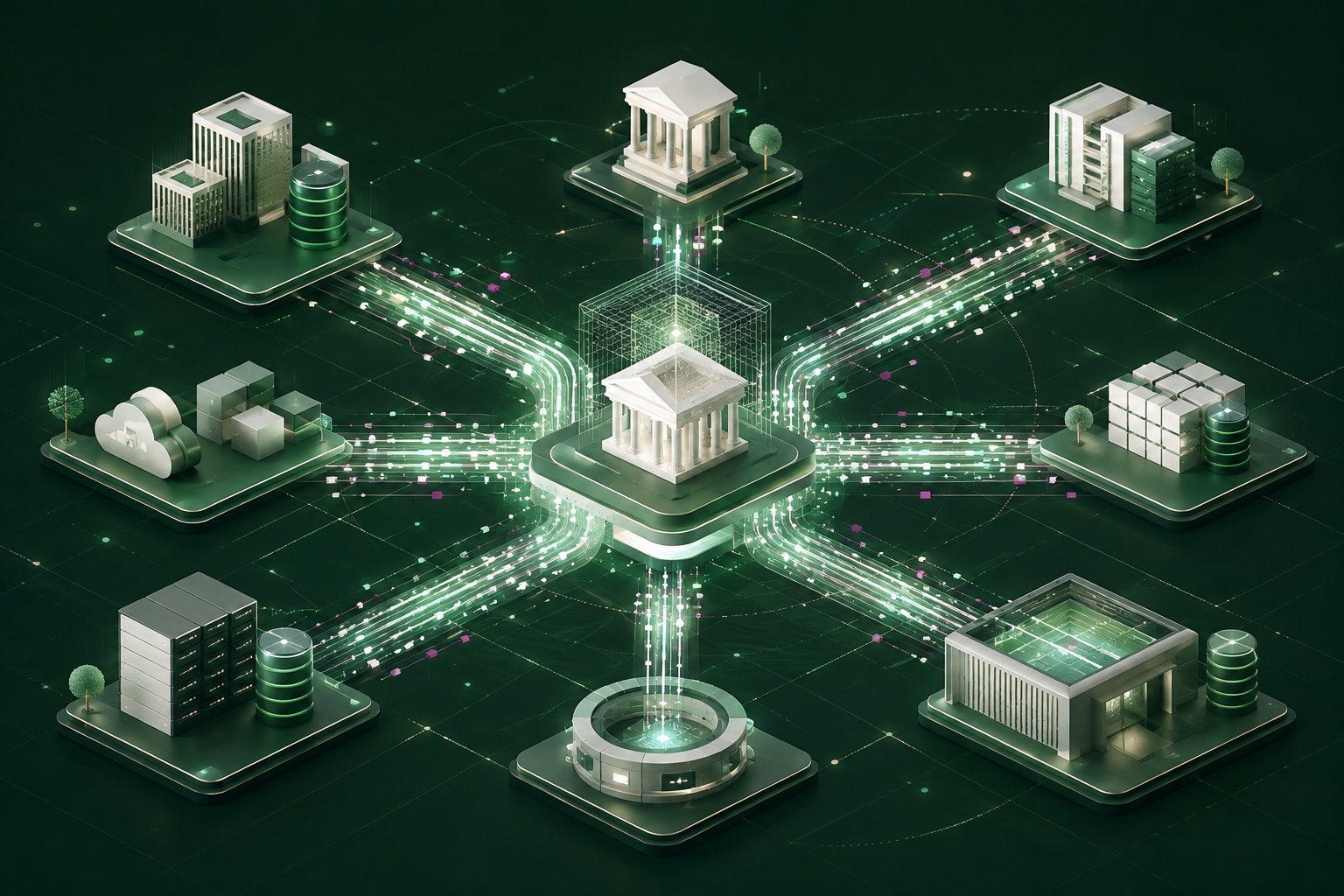
Modernising payments is not only about speed. It also depends on the quality of the information exchanged between banks, businesses, market infrastructures and their information systems. Without reliable, structured data, even a fast payment can still create manual checks, difficult reconciliation and limited visibility across the transaction lifecycle.
ISO 20022 provides a common business language for harmonising those exchanges. It creates a shared foundation for automating processing, improving traceability, supporting accounting reconciliation and making better use of payment data. Its value therefore lies not only in message syntax, but in preserving precise meaning from end to end.
1. What is ISO 20022?
ISO 20022 is an international standard developed for financial services. It defines a design methodology, a shared data model and a catalogue of messages spanning payments, Cash Management, securities, Trade Finance, cards and foreign exchange.
The standard is often associated with XML, a common syntax for transporting ISO 20022 messages. Yet it goes much further than a technical format. Its main contribution is a semantic model in which each data element has an agreed business definition and a clearly identified place in the message.
Information about the ordering customer, beneficiary, accounts, amounts, invoice references, payment purpose and regulatory requirements can therefore travel in distinct fields. This reduces ambiguity and helps successive applications interpret the data consistently.
2. Why was a common financial language needed?
Payment chains historically developed around SWIFT MT messages, domestic standards, proprietary formats and bank- or corporate-specific files. This diversity met local needs, but also multiplied interfaces and conversion rules.
- Complex mappings across applications and counterparties.
- Truncated, concatenated or unstructured data.
- Transaction rejections caused by differing format rules.
- Difficult reconciliation when references are incomplete.
- Costly manual investigations to recover transaction context.
- Fragmented traceability between initiation, execution and reporting.
By providing shared vocabulary and models, ISO 20022 helps preserve data quality across the payment chain. Information captured correctly at source can be reused by the bank, payment infrastructure, beneficiary bank, ERP and treasury tools without losing its meaning.
3. Rich data as an enabler for automation
Structured, consistent data supports higher Straight-Through Processing rates. It also improves payment-to-invoice reconciliation, ERP and TMS integration, payment-status tracking, financial reporting and cash-flow forecasting.
For compliance and risk teams, better-defined fields enable more accurate controls, can reduce false positives and create clearer decision records. Data teams can analyse payment behaviour, detect anomalies and support governed artificial-intelligence use cases.
These benefits depend on data quality at source. Mechanically converting a legacy message to ISO 20022 without improving reference data, controls and processes does not unlock the standard’s full value.
4. Benefits for banks and businesses
For banks
- Harmonise exchanges across payment engines, channels, compliance systems and reporting platforms.
- Improve automated processing rates and transaction traceability.
- Reduce investigations caused by incomplete or ambiguous data.
- Make compliance controls more precise through better-qualified information.
- Improve service quality and develop new data-driven services.
For businesses
- Transmit more detailed and consistent payment references.
- Improve accounting reconciliation and transaction matching.
- Gain better visibility over receipts, payments and statuses.
- Integrate more smoothly with ERP, TMS and accounting tools.
- Reduce manual processing and rekeying.
- Standardise bank communication in multibank environments and optimise Cash Management.
5. The SWIFT migration has entered a new phase
The coexistence period between legacy MT and ISO 20022 messages for cross-border payments and CBPR+ reporting began in March 2023 and ended on 22 November 2025. ISO 20022 is now the reference language for cross-border payment instructions exchanged over the SWIFT network.
The challenge is no longer simply being able to send or receive a message in the new format. Institutions must preserve, control and use the richness of the data across channels, payment engines, compliance controls, integration layers, reporting and accounting systems.
Temporary conversion can maintain technical continuity for some exchanges, but it is not a substitute for end-to-end transformation. The priority has shifted from format compatibility to data quality and operational value.
6. ISO 20022 in Morocco
Morocco is also part of this modernisation. Bank Al-Maghrib and the Moroccan Interbank Clearing System Group launched instant interbank transfers on 1 June 2023. The official announcement states that the platform complies with the international ISO 20022 messaging standard.
This infrastructure provides a concrete example of the standard supporting continuously available, interoperable payments. It also shows that modernising a payment service combines a data model, automation, security, business continuity and coordination among multiple institutions.
7. A transformation beyond message conversion
An ISO 20022 programme may affect digital channels, Host-to-Host platforms, APIs, integration middleware, payment engines, screening controls, accounting systems, reconciliation tools, reporting and Data Analytics platforms, as well as operational procedures.
The programme must bring together business, functional, technical and operational dimensions. A structured approach generally includes the following steps:
- Map the relevant flows, messages, counterparties and systems.
- Prioritise use cases according to value and criticality.
- Define mapping rules and mandatory data.
- Assess gaps between available data and the target model.
- Adapt applications, Host-to-Host interfaces, APIs and controls.
- Establish data-quality rules and governance.
- Run end-to-end functional, technical and operational tests.
- Train and support business, technology and operations teams.
- Measure data quality and automation rates after go-live.
ISO 20022 as a transformation programme
ISO 20022 should be approached as a business, functional and technology transformation rather than a narrow compliance exercise. It gives organisations a common framework for modernising payments, automating more operations and creating services based on better-structured financial data.
Success depends less on the ability to produce XML than on alignment between source data, processes, interfaces and use cases. Organisations that treat ISO 20022 as a data asset will be better positioned to realise value from Cash Management, bank integration and automation investments.
How Paytium can support your programme
Paytium supports banks, financial institutions and large businesses in shaping and delivering ISO 20022 programmes: impact assessment, flow mapping, legacy-message analysis, mapping design, integration architecture, Host-to-Host and API connectivity, migration strategy, test specifications, end-to-end testing and go-live readiness.